
You've got the land and you want a pole barn, a shop or a gravel pad for equipment, a camper or parking. Step one is getting the spot cleared the right way, without clearing more than you need.
- Check zoning and setbacks first. Township or county rules decide where you can build.
- Call 811 before anybody digs.
- Clear the footprint fully (stumps and roots out) plus working room. Mulch the rest.
- Plan drainage and access before the gravel goes down.
Before anything gets cleared
Check zoning, setbacks and permits
Accessory buildings like pole barns and garages usually have setback and size rules, and some need a permit. Those rules are set by your township, city or county, and they're different in Hamilton, Butler, Boone or Dearborn County. Call your local zoning office before you pick the spot, not after.
Call 811
Before any digging, stump removal or grading, call 811 (or submit online) to get underground utilities marked. It's free, it's the law in Ohio, Kentucky and Indiana, and it beats hitting a gas or electric line.
Think about access
A concrete truck, a gravel truck and the building supplier all need to get to the site. Plan the driveway or access lane at the same time as the pad. It's cheaper to clear it all in one trip.
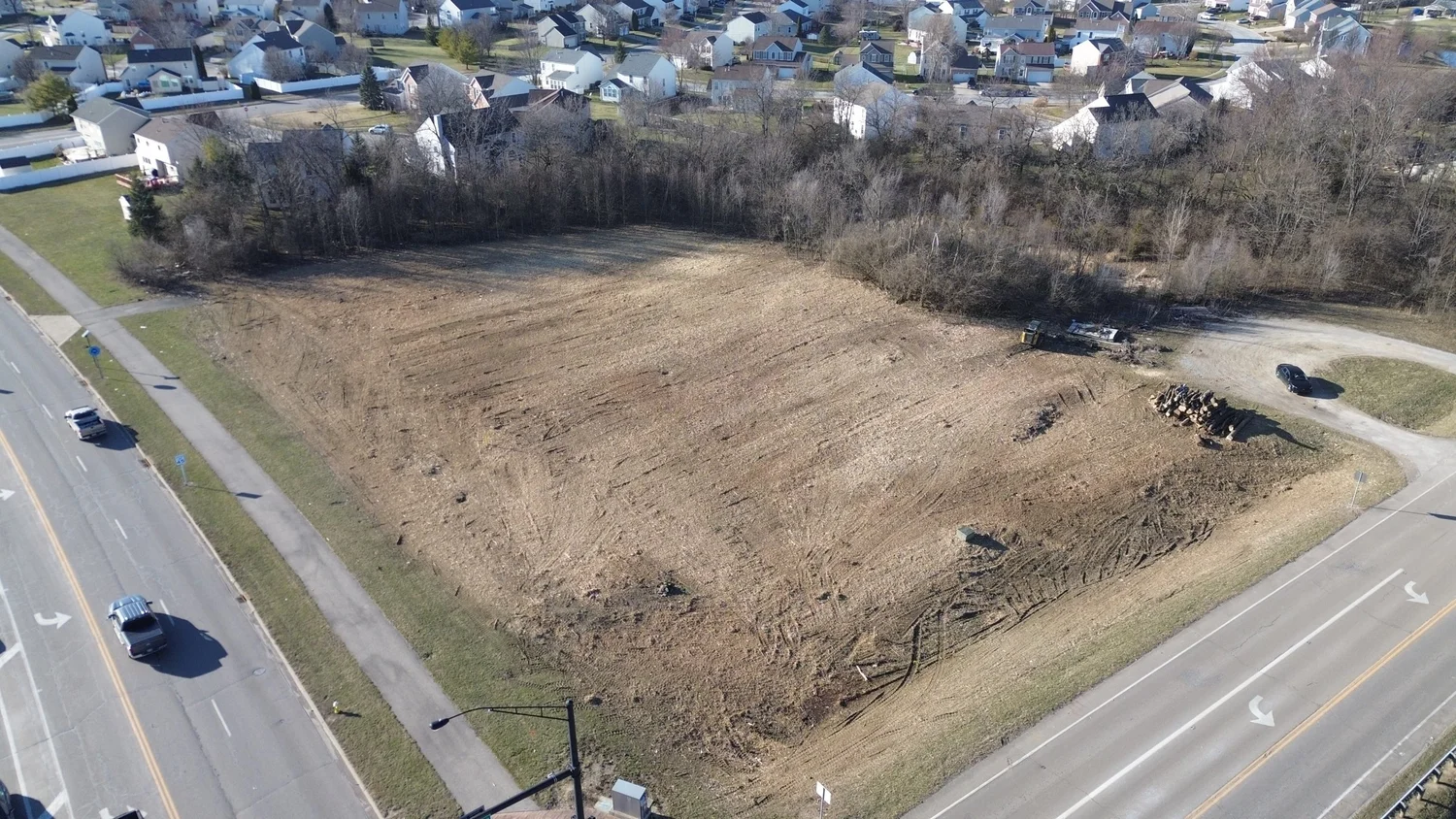
Clearing the spot
The footprint: full clearing
Wherever the building, slab or gravel goes, the stumps and roots need to come out. Organic material left under a pad rots and settles, and that's how you get soft spots and cracked concrete. Give yourself working room around the footprint too, so the builder has space for equipment and you have room for drainage.
Everything else: mulch it
The area around the building doesn't need to be stripped to dirt. Forestry mulching opens it up, keeps the soil covered and lets you keep the trees you want for shade and a windbreak. More on the difference in forestry mulching vs. bulldozer clearing.
Gravel pads: do the base right
A gravel pad that holds up starts with what's underneath:
- Strip the organic topsoil and roots from the pad area.
- Get the grade right so water runs off the pad, not onto it or toward your building.
- Use a coarse base stone with a finer stone on top, compacted.
- On soft or clay ground, a geotextile fabric under the stone helps keep it from sinking.
We do land conversion work like this: clear the ground, then put in the gravel pad or access so it's ready to use.
Common mistakes
- Clearing too much. Bare dirt you don't need is money spent and erosion to fight.
- Leaving stumps under the pad. They rot and the pad settles.
- Ignoring drainage. Water always wins. Plan where it's going.
- Forgetting the trucks. If a loaded concrete truck can't get there, you've got a problem.
Let's look at your spot
Tell us what you're building and where. We'll walk it, tell you what needs full clearing and what can just be mulched, and give you a price. See our land clearing page or give us a call.
Common questions
Do I need a permit for a pole barn?
Often, depending on your township, city or county and the building size. Check with your local zoning or building office before you pick the spot.
Do stumps need to be removed under a gravel pad?
Yes. Stumps and roots left under a pad rot and settle. The pad area should be cleared of stumps, roots and organic topsoil.
Should I clear the whole property for a building?
Usually not. Fully clear the building footprint, access and working room, and mulch the rest. It saves money and limits erosion.
Do I need to call 811 before land clearing?
Before any digging, stump removal or grading, yes. It's free and required in Ohio, Kentucky and Indiana.
Get a free quote
Bulk Co is a forestry mulching and land clearing contractor based in Harrison, Ohio, serving properties within 50 miles of Greater Cincinnati. Tell us what you've got and we'll come walk it.